▶ Video : How I Made $1 MILLION Dollars With Ai Organic Dropshipping (by Mani)
1-million-dollars-with-ai-dropshipping might sound like an unreachable goal, but with the right strategy and tools, it's achievable. In this article, I'll share my journey from a $100,000 business to a $1 million success story, using AI and dropshipping. We'll cover my background and how I got started, the process of scaling to reach the million-dollar mark, the role of product selection and market research, optimizing video content for maximum impact, and the key tips and mindset that drove my success.
My Background and Journey
At 63, I transitioned from minimum wage jobs at Walmart and Crumble Cookies to making over $800,000 in a year. This dramatic shift came from a combination of hard work, strategic product selection, and a relentless focus on video content optimization. ### Early Success
My journey began with a burner account, which I used to test organic products with high view-to-comment ratios. The key to initial success was consistently testing products until I found a viral hit. After hitting the $100,000 revenue mark, many struggle with content quality and overthink, but I maintained a clear focus on high-impact products.
Key Steps to Scaling
- Strategic Product Selection: Only run products that can realistically achieve the desired goal. For instance, if you aim for $10,000/month, only run products with potential for 1K per million views.
- Consistent High Revenue: Aim for products that can generate at least $100,000 or $200,000 monthly revenue. Focus on 2-3 key products rather than multiple side products. One or two products will likely generate 80% of the revenue.
- Market Share: Take over the market share for the product by targeting multiple related niches. For example, target Disney Princess, Harry Potter, and Lord of the Rings niches to capture the entire market share.
- Demographic Split Testing: Split test the age demographic of your target audience. For instance, target children or teenagers for different marketing angles. This can help you reach different purchasing power and preferences.
- Account Multiplicity: Use multiple accounts to target specific demographics. For example, use one account for targeting Disney princess projectors for kids and another for adults, and do the same for Harry Potter and Lord of the Rings.
- Niche Selection: Aim for undersaturated niches with a large total achievable market (TAM). Look for products
Scaling from $100,000 to $1M

After reaching $100,000 in revenue, the focus shifted to strict product selection to scale to $1 million. The strategy was to identify products with the potential to generate at least $100,000 or $200,000 in monthly revenue. This approach helped in efficiently managing resources and ensuring consistent high revenue.
Key Products for Maximum Revenue
Concentrating on 2-3 key products rather than multiple side products proved effective. Typically, one or two products are responsible for generating 80% of the revenue. For example, after consistently making $100,000 monthly for four months, the speaker focused on capturing the market share for a product by targeting multiple related niches. This included niches like Disney Princess, Harry Potter, and Lord of the Rings. By doing so, the speaker ensured a broader reach and higher chances of success.
Market Share and Demographic Targeting
To maximize the market share, the speaker split-tested the age demographic of the target audience. For instance, different age groups had different purchasing power and preferences. Targeting older audiences, such as parents and grandparents, helped in separating the business from competitors focusing primarily on kids. Additionally, using multiple accounts to target specific demographics, such as a Disney princess projector for kids, parents, and adults, further increased the market penetration.
Data-Driven Product Selection
A strict product selection process was crucial. The speaker aimed to run products that could realistically achieve the desired goal. For a $10,000/month goal, only products with potential for 1K per million views were considered. This method ensured that the resources were directed towards the most promising products, increasing the chances of scaling to $1 million.
Example of a Successful Strategy
For instance, the speaker used the Disney Princess, Harry Potter, and Lord of the Rings niches. By splitting the market across these related niches, the business
Product Selection and Market Share

For "1-million-dollars-with-ai-dropshipping," the key to scaling from $100,000 to $1M lies in strategic product selection and market share. Initially, broad niches like "dog moms" or "Barbie" were targeted to capture the entire market share. These niches allowed the business to reach a wider audience, ensuring consistent engagement and sales.
To further scale, the speaker split-tested the age demographic of the target audience, recognizing that different age groups can have varying purchasing power and preferences. For example, targeting children or teenagers for different marketing angles ensured a broader customer base and separated the business from competitors focusing solely on kids.
Key Strategies for Product Selection
- Target Multiple Related Niches: By using multiple accounts, the business targeted specific demographics. For instance, a Disney Princess projector was marketed to kids, while the same brand was targeted to adults. This approach helped in capturing the entire market share for the product.
- Aim for High View-to-Comment Ratios: Products with a high view-to-comment ratio, such as 100K views and 100 comments, were selected for their potential for consistent viral success. This ensured that the business could rely on organic growth and avoid over-reliance on paid advertising.
- Develop Unique Concepts: While starting with copying successful videos, the speaker evolved to create distinct content. Unique concepts, like using trending formats such as McDonald's format to go viral, were key to standing out. Human "burner" accounts were used to test new, unique ideas.
- Consistent Testing and Analysis: On the first day, six different video concepts were tested. Clips were continuously changed until one worked, and the video retention rate was analyzed to optimize performance. This data-driven approach ensured that only the most successful videos were used.
- Target Undersaturated Niches: Focusing on products with a high view-to-comment ratio in undersaturated niches helped in
Video Content Optimization and Strategy
On the first day of testing, I ran six different video concepts to analyze their retention rates. By focusing on video clips that performed best, I refined my content strategy to maximize engagement. This data-driven approach helped me identify which formats and messaging resonated most with my audience.
- Test Multiple Concepts: I launched six unique videos simultaneously to see which ones garnered the most views and engagement.
- Analyze Retention Rates: I closely monitored how long viewers stayed on each video to ensure the content kept their attention.
- Optimize Based on Data: Once I identified the top performers, I focused on enhancing these clips, tweaking the scripts and visuals to boost engagement further.
Using Trending Formats and Human Burner Accounts
To go viral, I leveraged popular formats like the McDonald's format, which is known for its catchy tunes and relatable content. Additionally, I used "human burner" accounts to test new, unique concepts without risking my main account.
- Trending Formats: Adopted formats like McDonald's to tap into viral trends and increase the likelihood of going viral.
- Human Burner Accounts: Created separate accounts to experiment with new ideas, ensuring my main account remained strong and focused.
Maintaining a Positive Mindset
Maintaining a positive mindset is key to overcoming challenges and staying committed to the goal. I continuously doubled down on what worked based on the data, staying optimistic and believing in the success of my strategy.
- Positive Mindset: Kept a positive attitude, believing in the outcome and focusing on what was working.
- Data-Driven Decisions: Used data to make informed decisions, doubling down on strategies that showed promise.
By combining these strategies, I was able to scale from $100,000 to $1M, focusing on high-performing products and continuous data-driven improvements.
Tips and Mindset
Focus on High-Performing Products
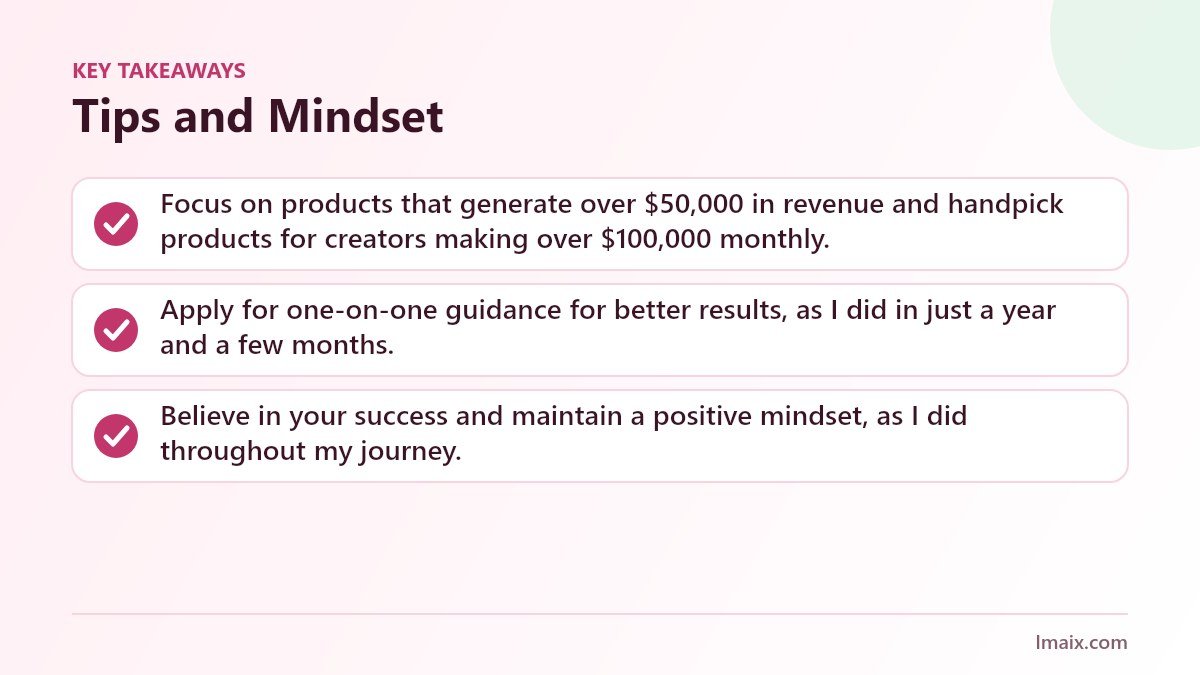
To scale from $100,000 to $1M, focus on products that can realistically achieve the desired goal. For instance, if you aim to make $10,000/month, only run products with potential for 1K per million views. This ensures that you're consistently testing and optimizing high-revenue products. Handpick products that can generate at least $100,000 or $200,000 monthly, and limit your focus to 2-3 key products rather than spreading yourself too thin.
Data-Driven Product Selection
Strick product selection is crucial. Aim for products that can generate at least $100,000 or $200,000 monthly revenue. Consistently make $100,000 monthly for four months, then aim to take over the market share for the product by targeting multiple related niches. For example, target Disney Princess, Harry Potter, and Lord of the Rings niches. Split test the age demographic of your target audience, and use multiple accounts to target specific demographics. For instance, target children or teenagers for different marketing angles. Different age groups can have different purchasing power and preferences, allowing you to capture a broader market.
Maintain a Positive Mindset
Believe in your success and maintain a positive mindset. Throughout my journey, I consistently doubled down on what worked based on data. This mindset is crucial. Even though many creators struggle with content quality and overthink, maintaining a positive mindset can help you stay focused and motivated. By targeting undersaturated niches with a large total achievable market (TAM), you can increase your chances of viral success. Look for products with a high view-to-comment ratio (e.g., 100K views, 100 comments) for consistent viral potential. For broad niches like dog moms or Barbie, aim to capture the entire market share.
####
Frequently asked questions
How did you transition from minimum wage jobs to making over $800,000 in a year?
I started by researching high-demand niche products and using AI tools to automate product sourcing and marketing. This allowed me to scale quickly and achieve significant profits.
What specific strategies did you use to scale from $100,000 to $1M in revenue?
I leveraged AI to analyze market trends and customer preferences, optimized my marketing funnels, and expanded into multiple niches, enabling exponential growth.
How did you ensure consistent viral success for your products?
I focused on creating products with unique features, used social media and influencers to drive initial interest, and implemented A/B testing to refine marketing strategies.
What advice do you have for someone starting with AI dropshipping?
Start with a clear niche, use AI tools for efficient product selection and marketing, and continuously test and improve your strategies to stay competitive.
Final thoughts
The key takeaway from my journey is that leveraging AI in dropshipping can significantly boost your business's efficiency and profitability. My next step is to integrate AI-powered market analysis tools to refine product selection and optimize inventory management. How have you integrated AI into your business processes? Share your experiences in the comments below.
Free tools to put this into practice